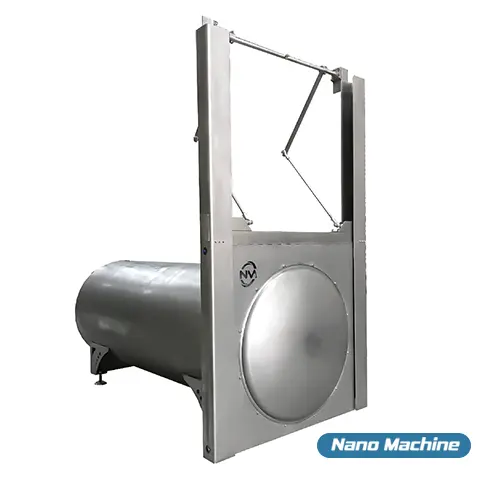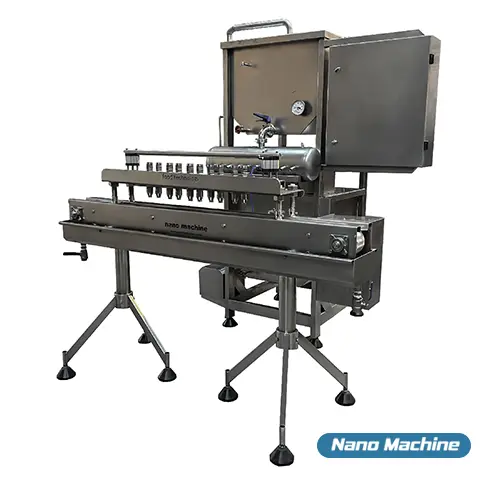

Exhaust box for canned food: removing air and forming a vacuum for a longer shelf life
Even heating with precise temperature control
Air left inside a can is the enemy of shelf life. Oxygen oxidises fats and changes colour and taste, it helps some microorganisms grow, and during sterilisation the expanding air can put pressure on the can and deform it. The Nano Machine can exhaust box is designed to remove this air before seaming.
In this machine, filled cans pass through a heating tunnel and their contents are heated evenly under precise temperature control. The heat expands the product and drives out the air in the top of the can; the can is then seamed immediately, and once it cools the desired partial vacuum forms inside. The result is canned food with a longer shelf life, more stable taste and colour, and an intact can body.
How does an exhaust box work?
Exhausting is one of the classic stages of canning and sits between the oil or brine dosing machine and the can seamer. To learn more about the stages of canning, see the Canning article on Wikipedia.
Filled cans enter
After oil or brine is added, the cans enter the exhaust tunnel on the conveyor.
Even heating
The contents of the can are heated evenly under precise temperature control.
Air removal
As the product expands with the heat, it drives the air out of the headspace at the top of the can.
Immediate seaming
The hot cans go straight to the seamer and are closed.
Partial vacuum forms
As the sealed can cools, a partial vacuum forms inside and the product is ready for sterilisation.
Exhaust box price
The price of an exhaust box depends on the capacity you need, the length of the heating tunnel, the can size and any customisation. Nano Machine sells this machine directly, with no intermediaries, and our engineers review your capacity and line layout before you buy. For the stages before and after, see the brine dosing machine, the can washing machine and the other canned fish production line machinery.
Direct from the manufacturer
Factory price, with no intermediaries.
One-year warranty
Full machine warranty for one year.
Ten years of after-sales service
Spare parts and service for up to ten years.
Installation and commissioning
Technicians sent to sites in Iran and abroad (Turkey and the Persian Gulf region).
Can exhaust box technical specifications
The Nano Machine can exhaust box is built with a capacity of 150 cans per minute, 1 kW power, dimensions of 5000 × 500 × 1500 mm and a weight of about 450 kg, making it an energy-efficient, narrow machine that fits easily alongside a canning line. The technical specifications can be customised to suit the line capacity and the can size.
Why is a partial vacuum vital for canned food?
The partial vacuum inside the can plays several key roles: it removes oxygen from around the product and prevents oxidation and changes in taste, it limits the growth of aerobic microorganisms, and it stops the can from bulging or deforming during sterilisation and storage. With the right vacuum, the can lid is also drawn slightly inwards, which consumers see as a sign that the can is sound.
If exhausting is not done properly, cans may swell after sterilisation or look defective and be rejected at quality control. Precise temperature control in the Nano Machine exhaust box keeps this risk to a minimum and keeps the quality of every can the same.
In plants that skip exhausting or do it manually and unevenly, part of the output usually ends up with swollen cans in the warehouse or even on the market, a problem that causes financial losses and damages brand reputation. With a continuous, controlled process, the exhaust box removes this risk on the production line itself.
In addition, because the product is still hot when it enters the autoclave, it reaches sterilisation temperature sooner, which can help optimise steam consumption and shorten each sterilisation cycle. In high-capacity canning lines, this side benefit brings significant energy savings. That is why the can exhaust box is an important link between filling, seaming and sterilisation in any professional canning line.
Precise temperature control and low energy use
Overheating can change the texture of the product, while too little heat does not remove all the air. The machine's temperature control system heats the contents of the can evenly to exactly the set temperature. At the same time, a power draw of only 1 kW keeps the operating cost of this stage very low.
- Removes the air inside the can and forms a partial vacuum
- Longer shelf life and no product oxidation
- Prevents can deformation in later stages
- Precise temperature control and even heating
- Low energy use and a narrow footprint
- Easy to operate and maintain
For an up-to-date price of the can exhaust box, technical advice and a design sized to your line, contact the Nano Machine team.
Applications of the exhaust box
The Nano Machine can exhaust box can be used in any line where the product is sterilised and stored in sealed cans, including:
Canned tuna and seafood
Removing air from cans of tuna, kilka (Caspian sprat) and sardines before seaming.
Canned meat and ready meals
Forming a vacuum in canned meat and ready-meal cans for a long shelf life.
Canned vegetables and legumes
Exhausting cans of peas, corn, beans and other vegetables.
Other canned products
Any food product packed and sterilised in a sealed metal can.
Operation and maintenance tips
For best results, set the exhaust temperature to suit the product and can size, and keep the gap between leaving the exhaust box and seaming as short as possible so the product does not cool before the can is closed. Daily cleaning of the tunnel and conveyor and periodic inspection of the heating system and temperature sensors keep the machine running reliably. The Nano Machine after-sales team teaches these settings during commissioning, and spare parts are supplied for up to ten years.
Why the Nano Machine exhaust box?
Nano Machine builds complete canned fish production lines, from fish cooking blanchers and the horizontal tuna filler to oil dosing machines, brine dosing machines, exhaust boxes and can washers. The exhaust box is designed to work together with this equipment, based on experience from projects in Iran and exports to Turkey and the Persian Gulf countries.
Summary for production managers
With a capacity of 150 cans per minute, precise temperature control and a power draw of only 1 kW, the Nano Machine can exhaust box removes the air inside the can and creates the vacuum needed for a long shelf life. It is a low-cost investment that prevents returns of swollen cans and loss of product quality.
To buy an exhaust box, share your line capacity and can sizes with the Nano Machine team to receive a technical proposal and a factory-direct price.